
A tune-up is the visit that finds a fraying cable or a tired spring while it is still a small job instead of a door stuck shut on a subzero morning. In Omaha the two moments that matter most are just before winter and just after the summer storms. The estimate is free, and nothing is done until you agree.
Tell us what the door is doing. The estimate is free and you can say no.
The visit starts with the opener released and the door lifted by hand. A door that drifts down or flies up is out of balance, and balance is the single best clue to how the springs are doing. From there the technician works through every moving part: the springs for gaps, rust and stretch, the lift cables where they wrap the drums and where they anchor at the bottom brackets, the rollers and their bearings, the hinges, and the tracks for bends, loose bolts and alignment.
Then the opener gets the same attention. Force and travel settings are set to the door rather than turned up to overpower it, the photo eyes are lined up, and the auto-reverse is proven against an object on the floor. The bottom seal and the weatherstripping along the sides are looked at last, and the technician lubricates the hinges, rollers and springs with a product meant for them.
Winter here goes after the door in a predictable order. Spring steel loses some of its give in hard cold, so a spring near the end of its life tends to let go on the first bitter morning of the season. The grease in open roller bearings stiffens until the wheels drag instead of turning. The rubber seal along the bottom hardens and cracks, and a cracked seal lets meltwater pool and freeze the door to the slab.
A visit in the fall concentrates on exactly those parts. Springs that are close to their limit are pointed out with the free estimate, so the replacement can happen on a weekday afternoon instead of at five in the morning with the car stuck inside.
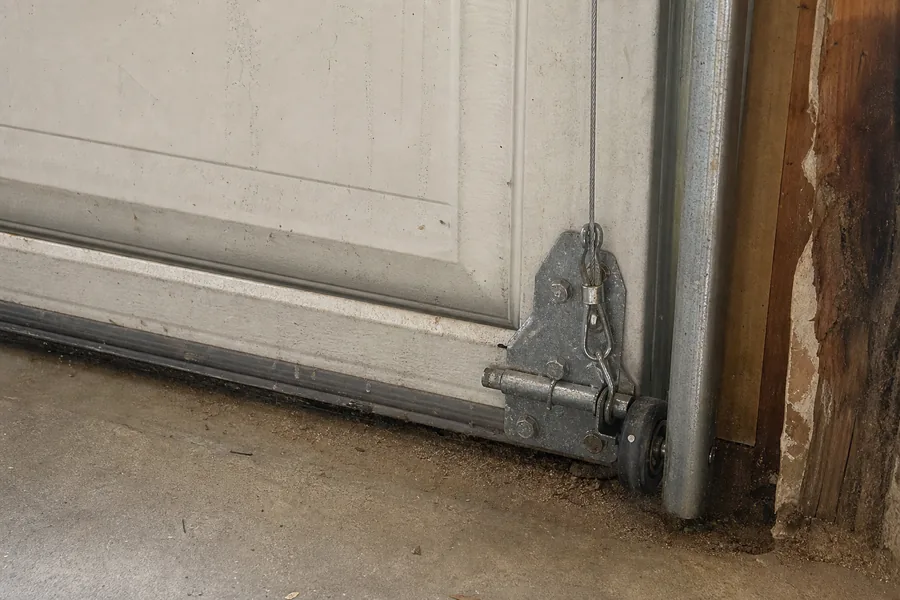
Salt and slush ride in on the tires all winter and drip right where the door meets the floor. That corner holds the bottom brackets, the ends of the lift cables and the lowest rollers, and it is where most cables start to fray, from the bracket upward.
Even when the call is about a noise near the top of the door, the bottom corners get looked at. A bracket that has rusted thin or a cable with a few broken strands gives no warning before it lets go, and finding it during a tune-up is the whole point of the visit.
Summer brings a different list. Hail dents sections and can bow one enough to rub in the track. Wind pushes on a closed door and can loosen track brackets or knock a track out of line. Power cuts during thunderstorms leave some openers out of step with their remotes or keypads, and a door that suddenly reverses for no reason often has photo eyes that were bumped out of alignment.
A visit after the storms catches these while they are still adjustments. If a section is cracked rather than dented, that shows up on the written findings with its own estimate.
Doors usually announce trouble before they fail. Grinding or popping on the way up, a squeal from the rollers, one side of the door lagging behind the other, a door that hesitates, travels slower than it used to, or stops and reverses on its own are all worth a call. So is a strip of daylight under a closed door, or an opener that strains and hums before the door moves.
None of these needs to be solved from the driveway. Describe what you hear and see when you call, and the technician starts the visit there. A short recording of the sound on your phone, played over the call, often says more than any description.
The same order every time, whether the door is a year old or forty.
When a door struggles, the opener usually gets the blame. Most of the time the motor is fine and the door is the problem: a spring that has lost tension, a dragging roller or a bent track makes the opener lift weight it was never meant to carry. Turning up the force setting only hides that, and it weakens the safety reverse at the same time.
A tune-up keeps the door light and balanced, which is also what keeps an opener going for years. If the opener itself is near the end of its life, you will hear that plainly, along with what a repair involves and whether a replacement makes more sense for a door that runs every day.
A hand-lift balance test, a look at the springs, cables, drums, rollers, hinges and tracks, the opener's force and travel settings, the photo eyes and the auto-reverse, the seals, and lubrication of the moving parts by the technician.
For most homes here, a visit before winter and another once the storm season is over covers the two hardest stretches of the year. A door that runs many times a day can need attention more often.
Noise is often the first sign: dry or worn rollers, loose hinges or a spring near its limit. It is worth having looked at before the part fails.
No. A snapped spring or cable is a repair. The visit tells you what failed, and the repair has its own free estimate.
Yes. Two-car and three-car garages can have every door looked at in the same visit, and each one gets its own findings.
Yes. The force and travel limits, the remotes and keypad, the photo eyes and the auto-reverse are all part of it.
Yes. Any repair the visit turns up comes with a free written estimate, and nothing beyond the tune-up is done without your yes.
Say what's wrong and we'll commit to an arrival window you can plan around. The visit and the estimate is free, anywhere in Douglas County.
Prefer a voice? Call (402) 897-6518.
Tell us what the door is doing. The estimate is free and you can say no.