A loading door that won't open stops deliveries, and one that won't close leaves the building open. We repair sectional overhead doors, rolling steel doors and roll-up doors on businesses around Omaha, from a single shop bay to a row of dock doors. The estimate is free.
Tell us what the door is doing. The estimate is free and you can say no.
Commercial doors come in a few families, and we repair all of them. Sectional overhead doors are the panels-on-a-track kind you see on shop bays and loading docks, often insulated on heated buildings. Rolling steel doors coil around a barrel above the opening and guard warehouses and service counters. Roll-up sheet doors close the units at storage facilities. Rolling grilles cover storefronts and pass-throughs.
The buildings vary just as much: auto service bays, contractor shops, warehouses, storage facilities, and metal buildings on farms and acreages at the edge of town. Each has its own habits, and the questions on the call are about how often the door runs and what goes through it.
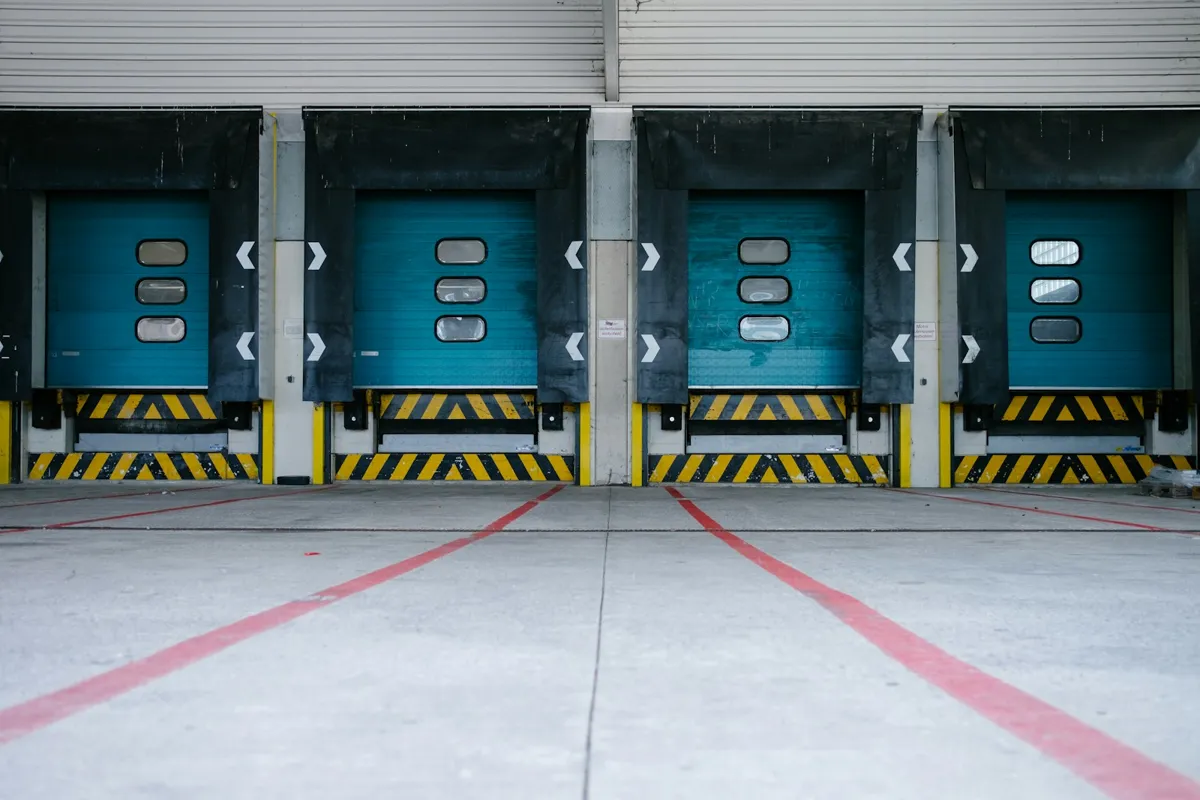
A door that cycles dozens of times a day wears through parts that a home door never touches in its lifetime. Springs are the usual first failure, and on a busy door they should be high-cycle springs sized for the work rather than whatever came with the building. Cables fray at the bottom brackets, rollers wear flat, and hinges crack along the center line of the sections.
Then there's impact. A truck backing in a little crooked or a forklift mast that's too high bends a section, kinks a track or tears the bottom bar. A single damaged section can usually be replaced on its own; a bent track is straightened or swapped so the door stops binding at the same spot every trip.
Winter here is hard on big doors. The bottom seal freezes to the slab overnight, and an operator that tries to lift a frozen door can strip a gear, snap a cable or trip its own overload. Snowmelt runs into the tracks and refreezes, and a door that rides over a ridge of ice starts throwing itself out of alignment.
Most of that is prevented with seals that are in good shape, springs that carry the door's real weight and operators set to back off rather than force their way up. On heated buildings, insulated sections and tight perimeter seals keep the warmth in and the door from sweating.
Shops, equipment sheds and pole barns out past the suburbs tend to have the widest doors we see, sized for a tractor, a camper or a work truck with a trailer. A door that wide catches the wind like a sail, and when a gust pushes it in or pulls it out, the rollers can pop out of the track and the sections can crease along a hinge line.
Struts across the sections stiffen a wide door, and track brackets fastened into solid framing keep it from flexing. After a storm, a wide door that suddenly binds or runs crooked should be looked at before it's forced; running it bent is how a small repair becomes a replaced section. Hail dents on these doors are usually cosmetic, and we'll tell you honestly whether a dented section needs replacing or just looks rough.
Commercial operators are built heavier than home openers and mount in different ways: trolley operators that ride a rail like a home unit, jackshaft operators that sit beside the door and turn the shaft, and hoist operators with a chain for opening by hand when the power is off. Most run from a three-button station on the wall.
Safety edges along the bottom bar and photo eyes across the opening stop and reverse the door when something is in the way. When an edge stops registering or the limits drift, the door misbehaves at the bottom of its travel. Those get tested on every visit, and a door still raised by a hand chain can be motorized.
A door stuck open at closing time is an urgent call. The first job is getting the opening secured, even if the full repair needs a part that has to be ordered, so the building isn't left open overnight.
Routine repairs are scheduled around your hours, and if a few doors need attention they're looked at on the same visit, each on its own line of the estimate. Nothing is done without the go-ahead of whoever you name as the contact.
The steps are the same for one bay door or a row of them.
A rolling steel door stores its springs inside the barrel above the opening, and as they weaken the door gets heavy to lift by hand or slow on its operator. Damaged slats can usually be replaced individually, and a guide bent by an impact is straightened so the curtain stops catching.
Storage-unit roll-up doors are simpler, but a facility can have dozens of them. A curtain that jumped its guide, a latch that won't catch, or a spring tension that has dropped off are all routine, and several units can be handled on one trip.
Yes. Sectional overhead doors, rolling steel doors, roll-up storage doors and rolling grilles are all part of the work.
Usually not. Damaged sections, bent tracks and torn bottom bars can be replaced on their own. The estimate tells you what the door needs.
Yes. Routine repairs are set for a time that suits the business. A door that can't be closed or locked is handled as urgent.
In most cases, yes. The door is checked first, since a motor should only ever lift a door that's balanced.
Yes. Shop doors, equipment shed doors and the wide doors on pole barns are part of the commercial work, as long as they're sectional, rolling or roll-up doors.
Call us and say the building can't be secured. Keep people and vehicles clear of the door until a technician has looked at it.
Yes. Each door is checked and listed on the estimate separately, so nothing gets lumped together.
Yes. The doors and the operators are looked at, and you get a written free estimate before any work is done.
Say what's wrong and we'll commit to an arrival window you can plan around. The visit and the estimate is free, anywhere in Douglas County.
Prefer a voice? Call (402) 897-6518.
Tell us what the door is doing. The estimate is free and you can say no.