
Swing and sliding driveway gates, the operators that move them, and the keypads and sensors that tell them to. Same day.
Tell us what the door is doing. The estimate is free and you can say no.
Automatic driveway gates, swing and sliding, and the operators that move them. Iron, steel and aluminum, single leaf or double. A gate that drags, a motor that hums and gives up, a keypad that stopped answering: the same crew that does garage doors across Omaha does this, with the same two-hour window.
A gate is a garage door turned on its side and left out in the weather. The hardware is different, the physics are not: a heavy panel, a motor that positions rather than lifts, safety devices that have to be right, and a whole lot of weight riding on a few bearings and hinges.
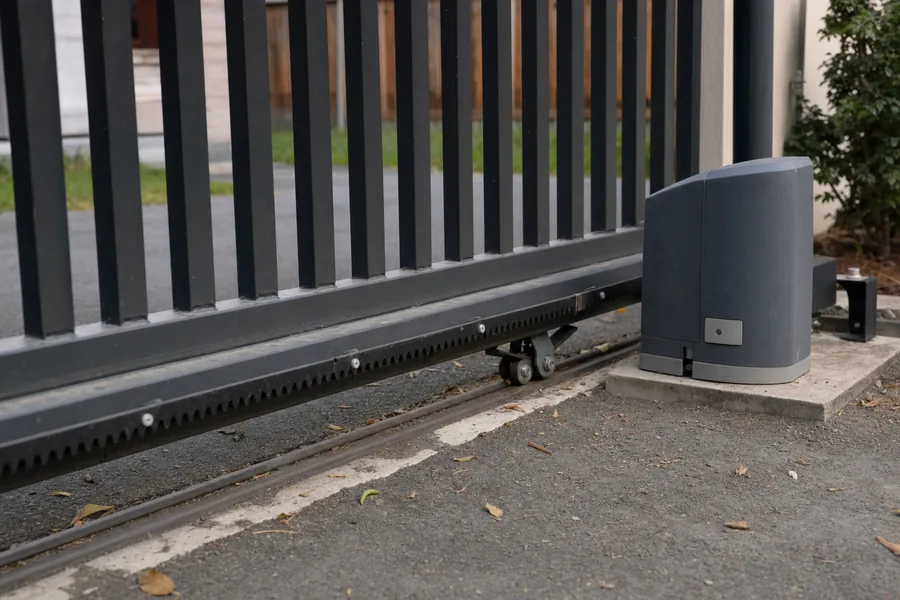
An automatic gate has more parts that can stop it than a garage door does, and they fail in a fairly fixed order. This is what we find, most to least often.
A residential operator is rated for a gate that swings freely by hand. Disconnect the arm on most gates we are called to and the leaf will not move without a shove. A hinge pin has worn, the post has heaved with the ground, or the leaf has sagged until the latch side scrapes. The operator has been dragging that load for months, and the board or the motor is the part that finally gives up.
So we do not start at the operator. We release it, swing the gate by hand, and put a level on it. Fix the hinge or the post and half the time the original operator is fine. Replace the operator on a gate that binds and you have bought the same failure again.
Omaha has extreme continental swings, and a gate stands in it all year with no roof over it. Where minus-ten mornings and hailstorms in the same year, a gate feels the same forces on parts that are smaller and more exposed than anything on a garage door. Hinge pins, roller bearings and the rubber of a safety edge all age faster outdoors.
The ground matters as much as the sky. A post set shallow moves with the seasons, and every fraction of an inch at the post is an inch at the latch. On sliding gates the concrete pad under the operator and the track itself shift the same way, which is why a gate that ran perfectly in one season binds in the next.
Same as a garage door visit, with a longer look at the gate before anyone touches the operator.
Half of the calls that begin as a broken gate end as a broken control. A keypad with a dead battery, a remote the receiver has forgotten, an intercom that rings the house but no longer releases the latch, an exit loop with a cracked wire under the driveway. We program remotes and keypads, replace receivers, repair loop detectors, and connect phone-entry and app-based access to operators that support it.
Safety is part of that. A gate that closes on a car or a child is not a convenience problem, so photo eyes and safety edges are checked on every visit whether or not they were the complaint.
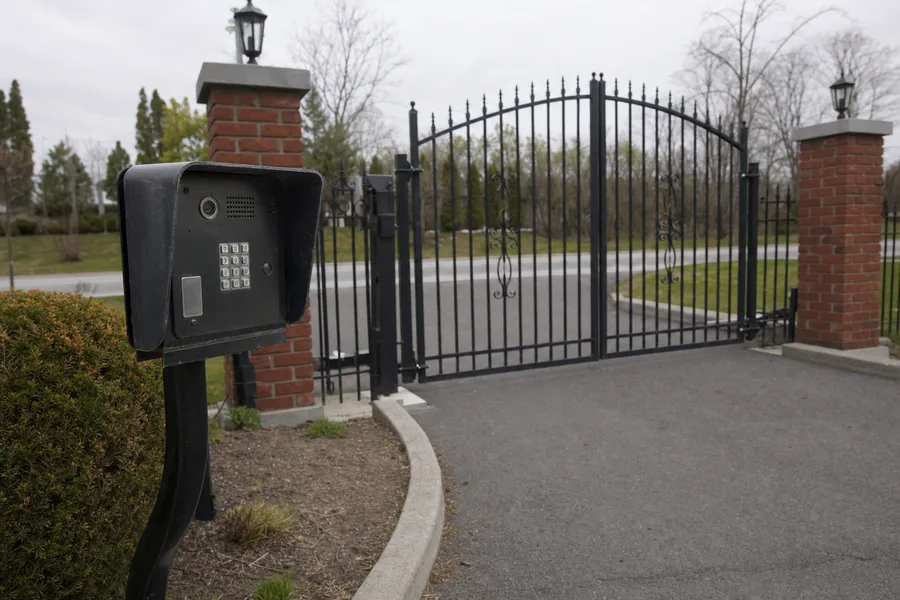
Most operators are worth keeping. A board, a battery, a limit adjustment, a new arm or chain, and the same machine runs for years. The cases for a new one are specific: a motor that has burned, a brand whose parts are no longer made, an operator undersized for the gate it is on, or one so old that no current safety device will connect to it.
When it is a new operator, we size it to the gate's real weight and length rather than to the box the old one came in, and we match swing to swing and slide to slide. Solar and battery-only units are an option where there is no power at the gate.
LiftMaster, Chamberlain, Mighty Mule, Nice and Apollo, Viking, DoorKing, Linear and OSCO, Elite, FAAC, GTO, US Automatic and Ghost Controls, plus the older brands still on posts around Omaha. Boards, batteries, arms and receivers for the common ones are on board; anything else is ordered and named at the visit.
Three things are worth trying, and none of them involves the operator's cover. Check the breaker or the plug at the gate. Change the remote battery. Look along the line of the photo eyes for a web, a leaf or a bin someone left in the way. If the gate is stuck shut and you need out, every operator has a manual release, usually a key or a lever on the arm, and it is safe to use.
What is not worth trying is forcing the gate against the arm. That bends the arm, strips the gear and turns a small repair into a bigger one.
A gate that will not move at all, hums, opens halfway or ignores the remote is usually the operator, not the gate. The motor, control board, power supply, battery or solar unit, photo eyes, remotes and keypads have their own page: electric gate opener repair in Omaha.
Both. Swing gates on linear or articulated arms, sliders on a ground track or a cantilever, single or double, in iron, steel or aluminum.
Almost always the safety sensors. A blocked or misaligned photo eye tells the operator something is in the way, so it opens and refuses to close. Rarely a bad board, usually an alignment.
Usually. Boards, batteries, arms, chains, receivers and photo eyes are carried for the common brands. A discontinued board or a custom hinge has to be ordered, and we say so at the visit.
Yes, and say so when you call. It moves up the list, and the gate is closed and secured before we leave even if a part has to come later.
Usually. If the motor is sound and the board is still made, a repair gives years more service. A burned motor, a brand with no parts, or an operator too small for the gate are the reasons to replace.
Yes. The gate has to move freely by hand and the post has to be solid, and we check both before recommending an operator sized to the leaf.
Yes. Remotes, keypads, receivers, intercoms and phone entry, plus exit loops and safety loops. Most of it is done in the same visit as the repair.
Around Omaha, one call gets you a two-hour slot and a heads-up call before the technician sets off. We don't buy leads and nobody on a phone judges a door they can't see.
Free estimate across Omaha, NE and the towns around it.
Say what's wrong and we'll commit to an arrival window you can plan around. The visit and the estimate is free, anywhere in Douglas County.
Prefer a voice? Call (402) 897-6518.
Tell us what the door is doing. The estimate is free and you can say no.