24 Hour Garage Doors covers Millard daily. Springs, openers, cables and off-track doors, same day where we can. Free visit and free written estimate.
An opener that will not run is the fault we're called out for most often in Omaha, and it's the one homeowners least expect. Nothing wears visibly, nothing sounds wrong, and then one morning the door won't lift and the car is shut in. Around Millard and Dundee we see it concentrated in mid-century ranches and large Elkhorn new-builds, where minus-ten mornings and hailstorms in the same year.
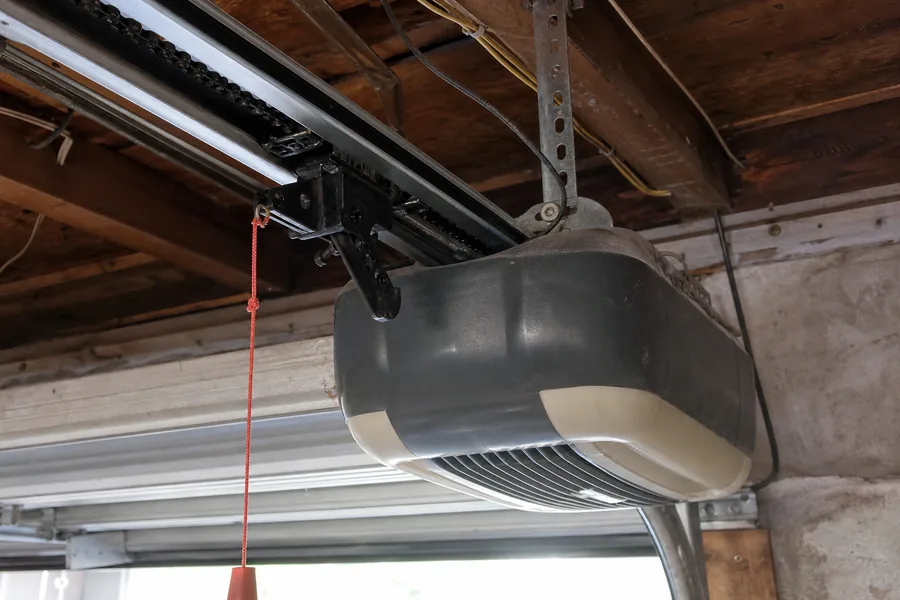
An opener doesn't lift anything. It positions a door that the spring has already made weightless, and holds it where it's put. The motor turns a worm which drives a nylon gear, and that gear is soft on purpose. Engineered to be the first thing to fail, because a stripped gear is an afternoon and a burned-out motor or a bracket torn off a door is not.
The van covers Omaha and Bellevue, Papillion, La Vista, Elkhorn daily. You get a two-hour window rather than a day, a free written estimate, and what was agreed on the driveway is what happens.
The tell is a mismatch between sound and movement. Press the button, the motor runs at completely normal pitch for its usual few seconds, and the door doesn't twitch. That is the gear, stripped, and a gear kit is a small fraction of a new opener. Look up at the rail: the trolley isn't moving either.
If any of that matches, a technician can diagnose it on site in about ten minutes. We don't guess at it down the phone, and we don't charge to look.
Safety reversal is the part that matters. Every opener sold since 1993 has photo eyes near the floor, and if the door doesn't stop and reverse when the beam is broken, that isn't a nuisance fault. It's the safety system not working. We test the reversal on every visit whether it was the reason we were called or not.
The general rule with a door that has failed is to stop using it. Every extra cycle you put through a door with a broken counterbalance transfers load onto parts that were never meant to carry it, and the job gets bigger with each attempt.
If you need the car out before we arrive, release the opener with the red cord only when the door is fully down, and lift with both hands and a straight back. If the door doesn't move easily, leave it. It's telling you the counterbalance is gone.
People put this off, and it is worth being straight about where that goes. None of the following is unusual. It's the ordinary sequence, and we see it in Omaha every week.
The visit and the written estimate are free, so finding out where you stand costs you nothing at all. That is the whole reason to call early rather than late.
Twice a year is the standard advice, and it's nearly right. What matters more in Omaha is which two times.
Do the first one before the cold arrives, because that's when springs, cables and the bottom seal are tested hardest. Lubricate the hinges, the roller stems and the spring coils, and check the balance by hand.
Do the second after the worst of the weather has passed, because that's when the damage is done and still simple to put right. A track knocked out of true, a hinge with an elongated hole, a seal that has stopped sealing.
Minus-ten mornings and hailstorms in the same year means neither visit is optional here in the way it might be somewhere milder.
The call itself takes about three minutes. We ask what the door is doing, what it sounds like, whether anything is visibly out of place, and roughly how old it's. That is usually enough to know which parts the van needs.
Loading the van from that description is the part that decides whether your garage door opener repair is a one-visit job or a two-visit job. It's also the part a national dispatch number can't do, because it doesn't know who is coming.
On site the technician confirms the diagnosis on the door. Sometimes the phone description was wrong. A 'broken opener' is quite often a broken spring. And it's better to find that out with the parts already in the van.
The estimate is written before work starts. The repair itself is usually under two hours, and the door is tested and balanced before anyone leaves.
Four faults cover most opener call-outs: photo eyes out of line, a stripped drive gear, a drifted limit switch, and a failed board. Three of those are a part and an hour. We tell you which one it's before you spend anything.
It doesn't, and this misunderstanding costs people openers. The spring carries the weight; the opener only moves a weightless door along its travel. An opener that's straining is telling you the spring is wrong, and replacing the opener won't fix it.
Frequency and rolling-code generation both matter. A modern Security+ 2.0 remote will not pair with a 1990s 315MHz head, and vice versa. Read us the model number off the back of the motor unit and we'll bring the right one.
None of that is unique to Omaha. It is simply what happens when a door is quoted over the phone by somebody who hasn't seen it, and it's the reason we don't give prices before a technician has stood in front of the door.
The difference between a job finished today and a job finished on Thursday is almost always whether the right part was on the van when it arrived. So the van is loaded for what Omaha actually breaks rather than for a national average.
Springs in the common sizes, lift cables, drums, rollers, hinges, brackets, opener gear kits, remotes, safety sensors and weather seal all travel with the technician. Panels and complete doors are ordered, and we tell you that at the estimate rather than on the day.
It's also why the description you give on the phone matters. Tell us what the door is doing, what it sounds like, whether it's a single or a double and roughly how old it's, and the van leaves already carrying the answer.
Almost every early failure we see in Omaha traces to one of four things, and all four are within a homeowner's control.
An unbalanced door. If the spring isn't carrying the weight, the opener is, and the nylon gear inside it's the part designed to give way first. An opener that strains is an opener with months left.
Dry hardware. Hinges and rollers that have never been lubricated add drag to every cycle, and drag is spent cycle life. It's the difference between a spring reaching its rating and falling well short of it.
Ignored warnings. A frayed cable, a seized roller or a door that has started to sit crooked is a straightforward repair for a few weeks and a much larger one afterwards.
And forcing it. Every attempt to run a door that has already failed moves load onto parts that weren't designed to carry it.
The question behind 'do you work on my brand' is really 'will you've the part'. For everything below the answer in Douglas County is yes, either on the van or within a day.
| Brand | Notes |
|---|---|
| Overhead Door / Raynor | Standard torsion hardware on the residential lines. Nothing unusual to source. |
| Genie | Screw-drive and belt-drive heads. Intellicode remotes and carriage assemblies are the usual failure points, and both are parts rather than a reason to change the opener. |
| Wayne Dalton | The TorqueMaster counterbalance is a spring inside the tube rather than on it, and it needs its own tools and its own parts. We carry them. |
| LiftMaster / Chamberlain | The same units under two names. Gear kits, logic boards and Security+ 2.0 remotes are stocked, and the older 315MHz heads can still be paired. |
| Sommer / Marantec | Less common here, direct-drive heads, and the parts have to be ordered. So we confirm the model before the van is loaded. |
| Clopay | The most common door brand we work on. Panels, hinges and struts are orderable individually, so one damaged section doesn't mean a whole door. |
Not listed isn't a problem. Residential doors are overwhelmingly standard hardware, and the handful that aren't are identified from the model number in about ten seconds on the phone.

One technician, one van, one job at a time, and the same process whether it's two in the afternoon or two in the morning.
The fault is confirmed on the door rather than guessed at down a phone line. The work is written down before anything is touched. Nothing is added afterwards. If something else is found once the door is apart, it's shown to you and agreed separately.
The door is cycled, balanced and its safety reversal tested before we leave, and the work is warranted in writing. That is the whole of it, across Douglas County.
Everywhere in Omaha, plus Bellevue, Papillion, La Vista, Elkhorn. Same rates across the whole area - there is no difference wherever you're inside it, and nothing charged for coming out.
Not on the list? Call anyway. The radius is about drive time rather than boundaries, and plenty of Douglas County falls inside it without having a line on this page.
If the opener is over fifteen years old and the board has gone, replacing it's usually the honest advice. A modern head is quieter, has a rolling code remote, and comes with its own warranty. We'll say so plainly rather than selling you a board for a unit that's finished.
No. The visit and the written estimate are free anywhere in Douglas County. You pay only if you agree the price and we do the work.
If a spring or cable has failed, no. Leave it down and don't force it. The counterbalance holds a great deal of stored energy and it can let go without warning.
Yes - Bellevue, Papillion, La Vista, Elkhorn and the wider Douglas County area are all inside our normal service radius.
Usually, yes. We hold same-day slots for Omaha and the surrounding towns, and a door stuck open or a car shut in goes to the front of the list.
A chain-drive opener runs 12 to 15 years. A belt drive runs about the same but quietly. What kills them early isn't age but load: an opener that has been pulling against a weak spring for a year has been working several times harder than it was designed to, and the gear inside is plastic.
There's no pressure attached to the call. Plenty of people ring to find out whether something is urgent, get told it isn't, and book for next week. That is a perfectly good outcome and it costs nothing.
If it's urgent. A door standing open, or a car shut in. Say so and it moves to the front of the list. Omaha, Douglas County and the towns around it.
Rated in cycles, not years, and it uses them faster than anyone expects. When it breaks the full weight of the door lands on a motor built to position it, not lift it.
What this costs and how fast →Four faults cover almost all of it. Photo eyes, drive gear, limit switch, logic board. Three of the four are a part and an hour.
What this costs and how fast →Rollers reseated, hinges checked for the damage a derailment hides, and the track trued against a level. Then we find what put it there.
What this costs and how fast →Frayed strands near the bottom bracket are the warning. Snapped is the emergency, and it usually takes the door off its track with it.
What this costs and how fast →A straight answer on the phone about whether it really needs somebody tonight, and the same parts and labor rates as a Tuesday morning.
What this costs and how fast →Rot or rust across more than one section, or repairs arriving more than once a year. At that point you're buying a door in installments.
What this costs and how fast →